



One of the most significant shifts came with the development of Zambia’s National Adolescent Health Minimum Package of Services. Through an inclusive and participatory process, WISH 2 supported the Ministry to finalise and validate this framework, creating, for the first time, a standardised and evidence-based guide for delivering adolescent-responsive services across all levels of care.
For years, efforts to improve adolescent sexual and reproductive health in Zambia were often fragmented, strong in intent, but uneven in implementation. Policies existed, but they were not always translated into practice. Planning and financing at sub-national level lacked consistency, and accountability mechanisms, while present, were not fully effective in driving change.
WISH 2 set out to address this gap, not by creating parallel systems, but by strengthening the ones already in place. Working in close partnership with the Ministry of Health, WISH 2 provided sustained technical assistance, capacity strengthening, and strategic advocacy to ensure that adolescent SRHR is not only prioritised, but embedded across the health system.
This gives us a clear standard, a Ministry official noted. We now have a shared understanding of what quality adolescent services should look like, and a consistent framework to guide implementation and accountability across all levels.
But WISH 2’s work did not stop at policy development.
At sub-national level, the project strengthened how plans are developed, financed, and implemented. Seventy-one provincial and district managers were trained in planning, budgeting, and financial management systems, improving how resources are allocated and used for SRHR. This has led to more focused, efficient, and realistic planning processes, ensuring that adolescent health priorities are reflected not only in policy, but in budgets and implementation.
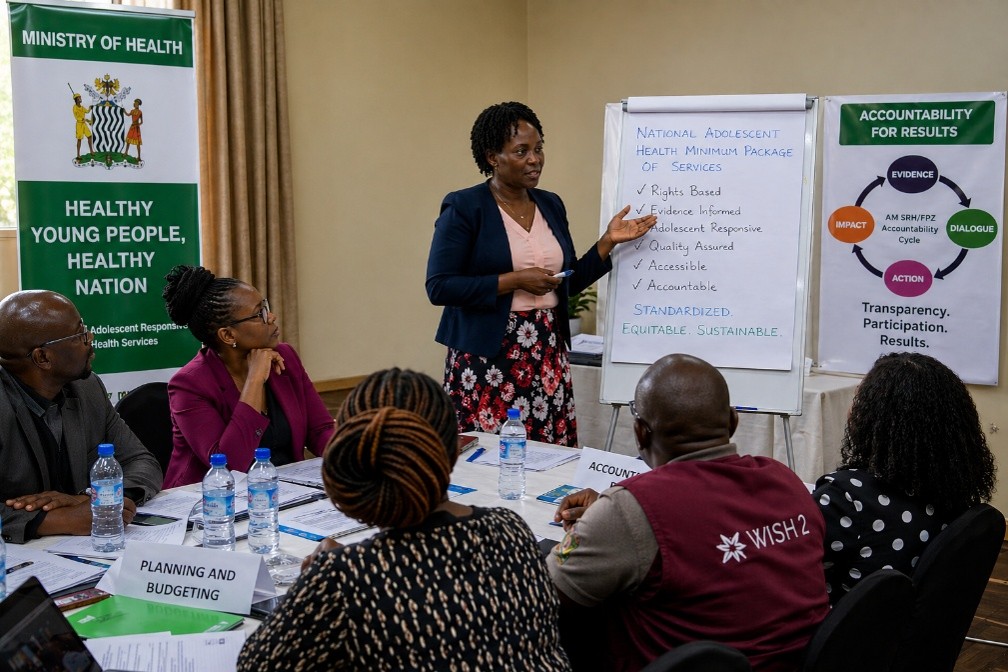
At the same time, accountability systems were transformed. Through sustained mentorship and technical support, the national SRHR accountability platform (AM SRH/FPZ) evolved into a more inclusive and coordinated mechanism. Its accountability score increased significantly, from 30% in 2019 to 81% by March 2026, reflecting stronger performance, better coordination, and more effective use of evidence to influence decisions.
This strengthened platform is now actively shaping national dialogue, informing budget discussions, supporting parliamentary engagement on family planning commodities, and contributing to debates on key issues such as age of consent.
At the policy level, WISH 2 also played a critical role in shaping the National Health Services Bill, supporting high-level engagement that secured consensus on progressive, rights-based provisions. These provisions are designed to expand adolescent access to SRHR services and align national legislation with constitutional and international commitments.
A stakeholder involved in the process reflected, this is not just about policies anymore. We are now seeing stronger systems, better coordination, and tangible accountability translating into improved service delivery.
WISH 2 has helped move Zambia from fragmented efforts to a more coordinated, evidence-driven, and government-led system, one that is better equipped to deliver equitable, adolescent-responsive SRHR services. And that is the difference WISH 2 makes, turning policy into practice, and commitment into measurable system-wide change.
when
country
Zambia
region
Africa